Followers

Saturday, September 6, 2008

Honda Insight Concept to Debut at Paris Int. Auto Show

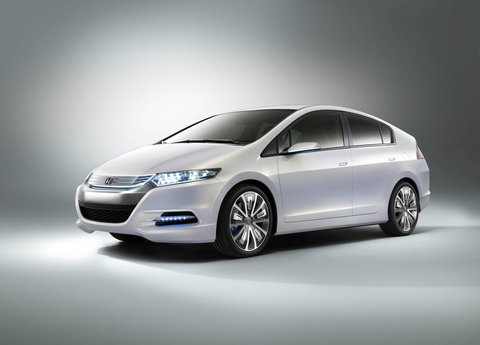
For months there has been chatter about Honda’s new 5-door hybrid, which has been hyped up as a Prius-killer. However, details have been scarce up until now, when Honda announced (and shared pictures!) of the Honda Insight Concept, which will be revealed on October 2nd at the Paris International Auto Show.

Much has been made of this car because of it’s low starting price (around $18,500) and higher people/hauling capacity when compared to the original Insight. The new Insight’s starting price will be lower than any other hybrid on the market, and was achieved by cutting the cost of Honda’s IMA system, which should lower hybrid prices across the board.

If you’ve been following the rumors, you’ll know that the new Insight Concept is based on the stylings of Honda’s fuel cell vehicle, the FCX Clarity, which is now on lease to a few lucky people out in California. This aerodynamics shape allows for a large interior while reducing fuel consumption tremendously, and doesn’t look half bad (I’m sure those wheels won’t come on the production model).

Expect to see the new Insight on Honda show-room floors in Spring of next year. Unlike the old Insight (and currently the Prius), we should expect the new Insight to be fairly available for purchase, as Honda intends to sell 200,000 units annually worldwide, with about half of those sales in the US. When more information is available to consumers, I will post again with pictures and links to the Honda site.

Read the full press release below:

TORRANCE, Calif. - Sep 04

Honda will reveal a concept version of its new small hybrid vehicle, to be named Insight, at the 2008 Paris International Auto Show, October 2, the company announced today. The new Insight Concept shares styling cues with the Honda FCX Clarity fuel cell vehicle and will provide an early look at the highly-anticipated five-passenger hybrid vehicle.

Going on sale in the U.S. next spring, the all-new purpose-built Insight will come to market at a price significantly below hybrids available today. From this unique position in the marketplace, the Insight will advance the affordability and accessibility of hybrid technology to a new generation of buyers.

“The original Honda Insight pioneered hybrid technology in the U.S. and remains a symbol of Honda’s commitment to innovative technology and fuel efficiency,” said Takeo Fukui, Honda Motor Co., Ltd. CEO. “This new Insight will break new ground as an affordable hybrid within the reach of customers who want great fuel economy and great value.”

The Insight Concept defines a new stage in the evolution of hybrid technology by utilizing a more cost-efficient version of Honda’s Integrated Motor Assist™ (IMA™) hybrid technology, resulting in a new level of affordability for hybrid customers worldwide. Evoking the innovative styling cues first seen in the FCX Clarity, the Insight Concept is designed with a low center of gravity and a generous five-passenger cabin, offering the kind of driving pleasure and roomy interior that customers have come to expect from Honda. While the Insight Concept’s aerodynamic design clearly identifies its fuel efficient purpose, its five-door access and folding rear seats speak to functionality that is designed to meet the needs of customers with an active lifestyle. The Insight Concept is a small, fuel efficient hybrid car that delivers big style and functionality with a healthy dose of fun.

Honda achieved a significant cost reduction in Integrated Motor Assist (IMA) components which should make Insight the most affordable hybrid vehicle to date. The production Insight will be offered as a five-door, five-passenger hatchback. Numerous technologies, including a function to assist customers in achieving more fuel efficient driving habits, will be applied to achieve a further improvement in real world fuel efficiency. With its affordable price, the new hybrid vehicle will represent the best value in its segment. Along with the Civic Hybrid, the new vehicle will be produced at an expanded hybrid vehicle production line at the Suzuka factory in Japan.

The Insight is expected to have annual global sales of 200,000 units per year - approximately 100,000 in North America. Following the launch of the new Insight, Honda also plans to introduce another unique sporty hybrid vehicle based on the CR-Z, first shown at the 2007 Tokyo Motor Show. All together, Honda’s global sales of hybrids should increase to approximately 500,000 units a year, or more than 10 percent of its total worldwide annual automobile sales.

The original Honda Insight was introduced in December 1999 as America’s first gas-electric hybrid car. The first vehicle to break the 70-mpg fuel economy barrier, Insight was designed from the ground up to demonstrate the ultimate potential for fuel-economy in a two-seater subcompact automobile.

A leader in the development of cleaner, more fuel-efficient mobility products, Honda introduced the first low-emission gasoline vehicles; America’s first gas-electric hybrid car and the world’s first EPA-certified hydrogen fuel-cell vehicle, the FCX. In 2007, Honda was named “greenest automaker” by the Union of Concerned Scientists for the fourth straight time.

Friday, September 5, 2008

Is Sushi Safe to Eat?

A Chicago man made the papers last month for suing a restaurant that allegedly served him a parasitic tapeworm along with his undercooked salmon. So what about the sushi or sashimi that hungry buyers pick up to go during the lunch hour rush?

Sushi lovers need not fret about the raw fish they consume, food scientists say, as long as the sushi has been prepared properly according to regulations by the Food and Drug Administration. People preparing sushi themselves need to take extra care with both the raw fish and the rice.

The usual suspects

Raw fish poses several potential hazards for consumers besides parasites. Bacteria can develop in non-fresh fish and produce enzymes called histamines that may result in Scombroid poisoning. Certain tropical-water fish may also have a natural toxin called ciguatera which causes gastrointestinal and neurological symptoms.

Sushi eaters don't typically have to worry because sushi restaurants take certain steps in handling and preparing their fish. A required step involves freezing fish at temperatures of -4 degrees Fahrenheit (-20 degrees Celsius) for seven days, or frozen at -31 degrees Fahrenheit (-35 degrees Celsius) for 15 hours, which kills any parasites.

"As far as sushi goes, the rules are in place because people were getting sick," said Keith Schneider, a microbiologist and food safety expert at the University of Florida. "The parasites are why we do the freezing on the raw fish."

The cases of sushi-related illness fall far below the number of people sickened by contaminated produce such jalapeno peppers. Even in those rare cases, the rice in sushi is more often the culprit than the fish.

"I got sick eating sushi at a place I go to occasionally – a fast food place, not a restaurant – and I could swear I came out with bacillus cereus," Schneider told LiveScience.

The bacillus cereus bacteria can spread rapidly in rice that sits at room temperature. Sushi rice requires an acidic bath in a vinegary solution that lowers the PH to 4.1, killing troublemaking microbes and making sushi safer for the everyday foodie.

Don't walk on the wild side

Many sushi lovers feast contentedly on albacore or eel, but a few people aim for a more dangerous culinary experience by eating the raw flesh of a poisonous puffer fish called fugu.

Master fugu chefs sometimes include some of the poison in their prepared dish, which creates a tingly feeling on the lips when eaten. However, improperly prepared fugu can kill due to the fish's potent neurotoxin.

"I consider it more of a dare than a delicacy," Schneider said. "There are people who kill themselves every year trying to make fugu, and it gives sushi a bad name."

As for trying to make sushi with raw meat other than fish, best perish the thought.

"Raw chicken, raw beef has probably much greater risk," Schneider said, pointing to bacteria such as E. coli and salmonella that can sicken thousands each year in the United States. "There are reasons you don't have chicken sushi."

Expert tips for happy sushi eating

  • The best bet for a good meal involves going to a restaurant or grabbing a sushi container from the local supermarket.
  • If you absolutely want to prepare your own sushi, buy sushi-grade fish that has been frozen per FDA regulations.
  • Eat your sushi as soon as possible, and do not let it sit in the fridge for more than 24 hours.

No food is completely without risk, but smart consumers can eat sensibly and enjoy – as long as fish are around.

Sept. 4, 1957: Short, Unhappy Life of the Edsel

In an industry celebrated for its spectacular failures, the Edsel still takes the cake. Although as mechanically sound as other Ford products, the car was criticized from Day One for being too ugly, too expensive and vastly overhyped.

The 1958 Edsel was intended to be an intermediate-level brand, bridging the gap between the cheaper Fords and pricier Mercurys and Lincolns. The most-affordable Edsel (the Ranger) cost 70 bucks less than Ford's top-end Fairlane, while the most-expensive model (the Citation) cost more than a Mercury Montclair.

In the post-mortem that followed the Edsel's early demise, the faulty pricing structure was cited by Ford as a big reason the car failed. Sales weren't helped, either, by the fact that it rolled out of the plant at the beginning of a recession. But there was more.

The Edsel -- named for Edsel Ford, Henry Ford's son who died of cancer in 1943 -- was the subject of an intense marketing blitz while still on the drawing board. The company promised an eager public something revolutionary, carefully baited the hook, and then failed to deliver. The Edsel was just another sedan on the basic Ford chassis.

Well, maybe not just another sedan. The classic barfly standard that everyone is good looking at closing time isn't true in this case. The Edsel was butt-ugly, period. A half century later, it's still butt-ugly.

Almost immediately after E-day, the superhype that had generated so much anticipation boomeranged on Ford. Automotive writers roundly trashed the Edsel, going so far as to compare the oval-shaped vertical grille to the female sex organ -- racy stuff for 1957.

Henry Ford II, who had opposed naming the car after his late father, believing it to be undignified, was no doubt furious and mortified. Robert McNamara, soon to become U.S. secretary of defense in the Kennedy administration, was president of the Ford Motor Company at the time and realized instantly he had a lemon on his hands. (A few years later, he'd be a little slower to realize that he had even a bigger lemon on his hands in a place called Vietnam.)

During the Edsel's first year, 1958, four models were produced and barely more than 63,000 were sold in the United States. Sales dropped in 1959, even though Ford had cut back to just two models, and on Nov. 19, 1959, barely two years after E-day, the company threw in the towel on the Edsel.

In one of those little logic-defying ironies, the Edsel today is a prized collector's item, fetching as much as $200,000 for a rare 1960 convertible.

Another victim of this historic automotive fiasco was the name Edsel itself. Although never a particularly popular boy's name -- rising to 400th on the 1927 list -- Edsel (from the Old German Adal, meaning "noble") has almost entirely vanished.